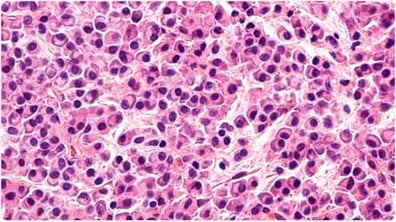
An emerging biopharma sponsor needed a fully validated Nectin‑4 IHC CTA to support patient selection in a solid tumor development program. There was no fully validated, clinical-grade assay available off the shelf, and the sponsor needed one that would hold up under CLIA-grade testing and scale into a growing clinical footprint. Precision's Winston‑Salem Histology team took the work from antibody screening through analytical validation and clinical deployment inside a single facility.
|
Client Type: |
Emerging Biopharma |
|
Location: |
Precision for Medicine, Winston‑Salem, NC |
|
Therapeutic Area: |
Oncology (Solid Tumors) |
|
Capability: |
Immunohistochemistry (IHC) Assay Development, Validation & Clinical Testing |
Challenge: Why Nectin‑4 IHC Testing Is Difficult for Clinical Programs
The sponsor required a reliable, scalable assay to evaluate Nectin‑4 expression in formalin-fixed, paraffin-embedded (FFPE) tumor samples across a clinical development program. Key challenges included:
- Lack of a fully validated, clinical-grade IHC assay for Nectin‑4
- Need for high specificity and reproducibility across diverse tissue types
- Requirement for CLIA-compliant testing to support regulatory-grade studies
- Anticipated need to scale testing to hundreds of clinical samples
Each of these had to be addressed inside a single workflow so results generated in development translated directly into what the clinical program could rely on downstream.
Solution: End-to-End Nectin‑4 IHC Assay Development and CLIA Validation
The Precision for Medicine Histology team in Winston‑Salem delivered an end-to-end assay solution, spanning development through clinical deployment.
1. Assay Development & Optimization
The team evaluated multiple antibody candidates across a range of concentrations and antigen retrieval conditions to identify the combination that produced clean, interpretable signal on FFPE tissue. Custom control tissues were designed and implemented to benchmark assay performance, including placenta, skin, and urothelial carcinoma, so every run had a defensible reference point for both intensity and localization. Staining was optimized for clear membranous expression, which is the pattern expected for Nectin‑4 biology and the pattern pathologists need to see for scoring to be reproducible.
2. Analytical Validation (CLIA)
The team conducted rigorous validation to confirm analytical sensitivity and specificity along with intra- and inter-assay reproducibility. The final assay was shown to be concordant, reproducible, and robust enough for clinical testing, and it was deployed inside the CAP-accredited, CLIA-certified laboratory environment at the Winston‑Salem site. Validation packages were structured so results and documentation could be referenced directly by the sponsor's downstream regulatory team and support clinical activities.
3. Implementation for Clinical Trials
A standardized IHC workflow was established on the Roche Ventana BenchMark ULTRA platform and integrated into existing histology processes, including microtomy, automated staining, QC and control acceptance, and pathologist review and scoring. The workflow was built to run in clinical batches, which supports steady turnaround as sample volume grows. Typical batch size runs in the range of 20 to 28 slides, which gives the sponsor a predictable operational rhythm to plan enrollment and testing cadence around.
Results: Nectin‑4 IHC Assay Performance and Clinical Readiness
- Delivered a fully optimized and CLIA-validated Nectin‑4 IHC assay ready for clinical deployment
- Achieved robust, reproducible staining with strong signal-to-noise characteristics
- Confirmed specific expression patterns across relevant tissues, including positive staining in placenta, tonsil, skin, and urothelial carcinoma, and negative or non-specific staining in liver and spleen
- Enabled seamless analysis of large clinical cohorts, supporting biomarker endpoints in oncology studies
Impact for the Client: How a Validated Nectin‑4 Assay Accelerates Oncology Trial Timelines
The validated assay gave the sponsor a running start on clinical readiness rather than a build-from-scratch delay heading into enrollment. Regulatory-grade documentation and a reproducible workflow lowered downstream risk on data integrity, which matters most when Nectin‑4 expression is being used to inform clinical decision-making. The result is a scalable testing framework the sponsor can lean on for the current program and carry forward into future studies without re-litigating the science each time.
Why Precision for Medicine? Integrated Biomarker Assay Development and Clinical Testing Under One Roof
Winston‑Salem brings integrated biomarker expertise under one roof, from assay design through clinical testing, so hand-offs that typically slow biomarker programs stay inside the same team. Execution runs on CLIA and CAP-aligned workflows and validation standards, giving sponsors a defensible package for regulators and reviewers. Operational scale is proven across large, multi-batch clinical studies, and the working posture is one of scientific partnership tailored to each sponsor's development goals.