
In a global Phase 3 colorectal cancer study, Precision's North American team turned a focused site management engagement into a pivotal contribution. When enrollment stalled after activation, the team built a prescreening tracker from scratch, identified a hemoglobin threshold that was systematically excluding eligible patients, and worked alongside the sponsor to amend the protocol.
Enrollment recovered, the study met its target, and the relationship endured well beyond closeout. The work demonstrated something that operational intelligence, even within a limited scope, can reshape the trajectory of a multinational trial.
|
Therapeutic Area |
Oncology |
|
Indication |
Colorectal Cancer (Advanced, Stage III or IV) |
|
Study Phase |
Phase 3 |
|
Number of Patients/Sites |
490+ Patients**, 90+ Sites** |
|
Patient Duration |
~3.5 Years |
|
Study Design |
Randomized, Multinational Biosimilar |
|
Project Mandate |
North American Site Management |
|
Clinical Products |
Site Management, Clinical Monitoring, TMF Collection, Targeted SDV, Health Canada Regulatory Submissions, Regional Translation Vendor Management |
** Across entire global study
A Focused Engagement for a Sponsor's First North American Phase 3
The sponsor, a Sweden-based pharmaceutical company, had completed Phases 1 and 2 in Europe. Phase 3 brought the program to North America for the first time, and with that expansion came a set of operational realities the sponsor had not yet navigated.
Precision was engaged to provide site management and clinical monitoring support across the United States and Canada. The sponsor retained global oversight, FDA submission responsibilities, data management, biostatistics, and safety. Precision operated under its own SOPs, with one exception: the sponsor's clinical monitoring plan was followed for targeted SDV, which contained the site-specific review criteria.
The scope was focused by design. There was no data management team on Precision's side, no biostatistics lead, no safety function. The DPM oversaw financials while the CTM managed operations, and for a period those roles were held by the same person.
"Our remit was regional site management, but the way we approach these engagements is to treat the scope as a starting point, not a boundary," says Erica Donnelly, who served as the study's CTM and de facto project manager. "If something is affecting enrollment or data quality, it falls within our line of sight regardless of whether it's in the contract."
Once sites were live across North America, the expectation was that enrollment would follow. The investigators were experienced in colorectal cancer. A biosimilar comparison to an established standard of care should have made the trial appealing to patients and sites alike. Instead, enrollment lagged. Sites were screening patients but not converting them at expected rates. Individually, each site's numbers looked explainable. Collectively, the pattern pointed to something structural.
Finding the Signal Behind a Stalled Enrollment Curve
The challenge was diagnostic before it was operational. Enrollment was not failing because of site disengagement or lack of patient access. Sites were actively screening. The conversion from screening to enrollment was where the funnel broke, and the reason was not immediately visible.
"We were seeing consistent screening activity across the network, but the conversion rates were not matching what the protocol design anticipated," Donnelly explains. "That disconnect between screening volume and enrollment output told us the barrier was somewhere in the eligibility criteria, not in the sites themselves."
This was before the dashboards and centralized tracking systems that exist today. There was no automated way to aggregate prescreening data across the network. If the team wanted to understand why patients were screening out, they would need to build the visibility from scratch, manually, across every active site.
At the same time, the engagement carried a second operational constraint that would surface later. The sponsor's data management vendor did not have the capability to program the reports needed for targeted SDV. That limitation had not yet become acute, but it represented a known gap that would require a workaround once the study moved into data cleaning. The team was managing a lean engagement with structural dependencies on vendors it did not control.

Building Evidence, Securing a Protocol Amendment, and Adapting Under Vendor Constraints
Prescreening Intelligence
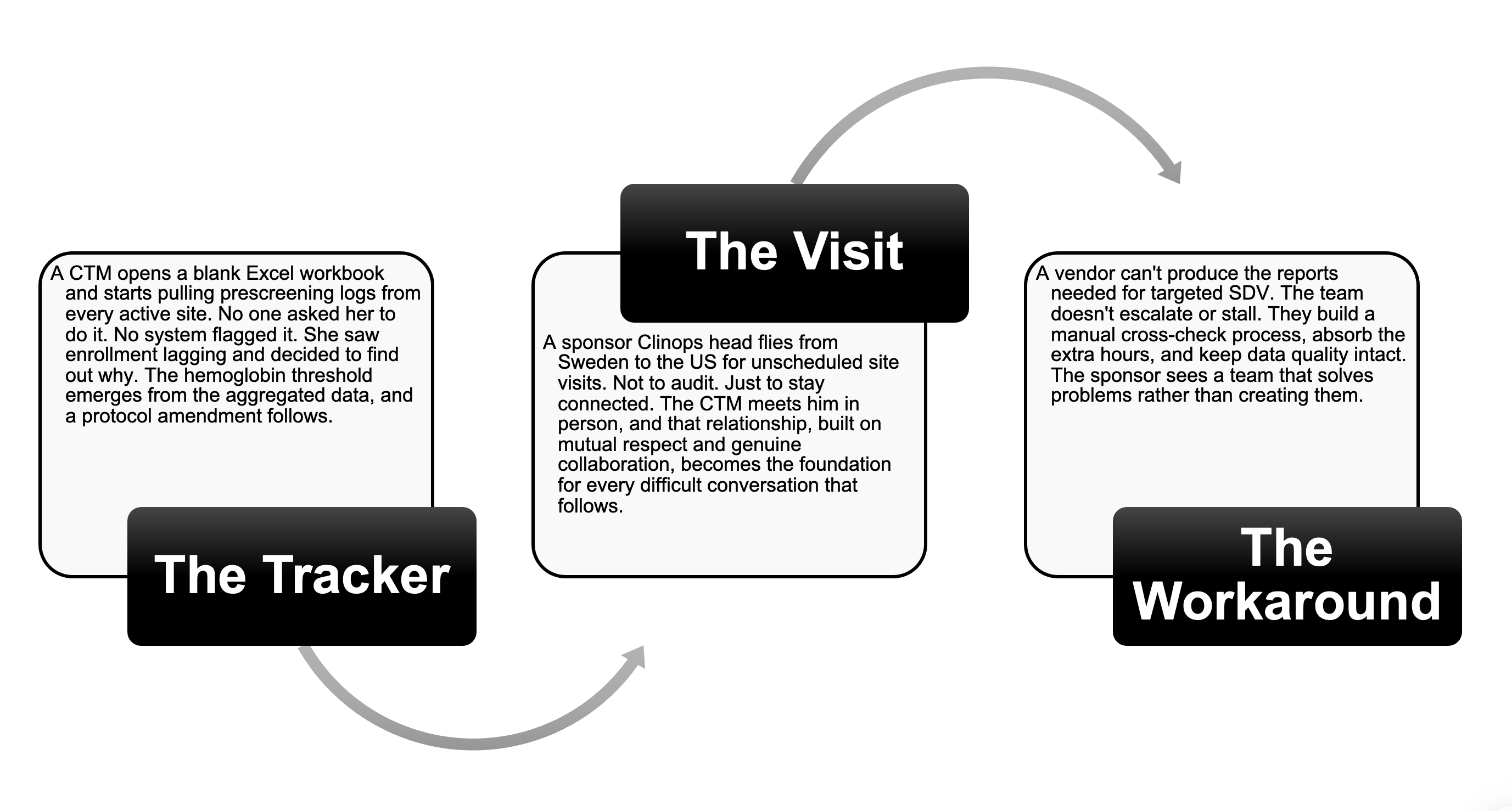
Donnelly built a centralized Excel tracker and began collecting prescreening logs from every active site. The work was manual, time-intensive, and entirely self-initiated. No system flagged the enrollment gap as a prescreening issue. No one requested the analysis. The decision to investigate at the prescreening level came from clinical judgment and operational instinct.
"By centralizing the prescreening data across the full site network, we were able to identify a pattern that was invisible at the individual site level," Donnelly explains. "A hemoglobin eligibility threshold was systematically screening out patients who were otherwise appropriate candidates. No single site had enough volume to see it on their own. It only became visible in the aggregate."
The hemoglobin threshold had been clinically reasonable at the protocol design stage, but its interaction with real-world patient demographics across North America was narrowing the eligible population beyond what the enrollment model had anticipated. The team brought the finding to the sponsor as a data-supported observation with a specific recommendation: adjust the threshold and re-evaluate through the medical monitor.
A Protocol Amendment Built on Collaboration
The sponsor's response demonstrated the strength of the working relationship. The medical monitor reviewed the recommendation, confirmed that adjusting the threshold introduced no additional safety risk, and a protocol amendment was issued.
"The amendment moved through quickly because the groundwork had already been laid," Donnelly says. "When you've established credibility through consistent communication and transparent reporting, a recommendation like this is received as evidence, not as criticism. The sponsor understood the data and acted on it."
Enrollment recovered following the amendment. The sponsor's Clinops head, who regularly flew from Sweden to the US for site visits to stay connected to the program, had built the same kind of trust from the sponsor side. That mutual investment in the relationship is what made it possible to propose a protocol change and have it acted on without delay.
Maintaining Data Quality Under Vendor Limitations
Once enrollment stabilized and the study moved into data cleaning, the vendor constraint became operational. The sponsor's data management vendor could not produce the reports needed for targeted SDV. The team implemented manual cross-checks: full review for the first patient at each site, with every fourth patient reviewed against a subset of criteria. It was 100% source data review, just not automated.
"We identified the vendor limitation early and built a manual review process that maintained the same data quality standards," Donnelly says. "For a study spanning 90+ sites, that represents a meaningful increase in CRA hours, and we communicated that cost implication transparently to the sponsor. Their vendor constraints were fixed, so we adapted our process to ensure the data held up."
The CRAs absorbed the additional effort, and data quality held throughout.
Moments That Mattered

On-Time Enrollment and a Relationship That Outlasted the Study
Enrollment recovered after the protocol amendment, and the study met its target. The 490+ patients across 90+ sites represent not just a completed enrollment goal, but a recovery built on evidence and sustained through operational discipline. Patients remained on study for approximately 3.5 years on average, a duration that speaks to both the clinical design and the stability of the operational infrastructure supporting long-term follow-up.
"The outcome validated the approach," Donnelly says. "When you invest the time to understand why enrollment is underperforming rather than simply escalating the pressure on sites, you get a solution that's durable. The amendment didn't just restore enrollment. It aligned the protocol with the reality of the patient population."
The relationship between Precision and the sponsor outlasted the study itself. Even after the sponsor scaled down operations, Donnelly maintained contact with the Clinops head. "Relationships like these are what differentiate clinical research partnerships from transactional vendor arrangements," she says. "Years later, across continents, the connection is still there. That's what we foster at Precision, and I believe it's one of the most important assets we bring to the industry."
Lessons Learned
|
Prescreening data is a diagnostic tool. |
Enrollment challenges don't always have obvious causes. Aggregating prescreening logs across the site network revealed a pattern no single site could identify on its own. The hemoglobin threshold barrier was hidden in plain sight until the data was viewed collectively. Root-cause analysis should begin at the prescreening level, not the enrollment report. |
|
Scope does not determine impact. |
Precision's engagement was limited to North American site management. The prescreening tracker that identified the enrollment barrier was not a contractual deliverable; it was an operational decision made by a CTM who recognized that something was off and chose to investigate. Regional teams can drive study-level outcomes when they operate with initiative and intelligence. |
|
Collaborative relationships enable fast action. |
The protocol amendment moved quickly because the sponsor-CRO relationship was already strong. Trust built through months of consistent communication and transparent reporting made it possible to propose a change and have it acted on without delay. Operational credibility is earned before it's needed. |
|
Vendor limitations require operational agility. |
When the DM vendor could not produce targeted SDV reports, the team absorbed the burden rather than escalating and waiting. Manual cross-checks maintained data quality and kept the study moving forward. Anticipating vendor gaps and building workarounds is part of operational maturity. |
|
Relationships are long-term assets. |
The CTM still communicates with the sponsor's Clinops head years after the study closed. That kind of connection comes from genuine collaboration and mutual respect, and it carries forward into future opportunities. |
This study reinforces a principle that is easy to acknowledge but difficult to execute in practice: that operational intelligence, even within a limited scope, can reshape the trajectory of a multinational trial. The prescreening tracker was not in the contract. The manual SDV workaround was not in the plan. The relationship that outlasted the study was not in the metrics. All three emerged because the team treated its scope as a starting point and operated with the initiative and discipline that the study required.
Precision for Medicine brings this same level of operational intelligence and collaborative rigor to every engagement, regardless of scope. If you're planning a multinational study, navigating enrollment challenges, or looking for a regional partner who operates like a strategic one, our team can help.
Let's talk about how we can support your next study.