A small European biotech company required end‑to‑end regulatory, scientific and assay validation support to transform an exploratory IHC assay into a multi‑indication, multi‑region patient‑selection tool across the US and Europe.
The sponsor entered early‑phase development with a novel biomarker and no prior experience navigating IVD regulations globally. Their forward progress depended on selection of the right partner—one that could pair a CDx regulatory strategy with lab execution from day one. Our IVD Regulatory team and laboratory scientists worked as a single unit: translating study objectives into submission-ready evidence, shaping validation plans around EU/UK/US expectations, and keeping clinical timelines moving while the assay matured into a multi‑indication, multi‑region patient-selection tool.
This partnership was practical and continuous—not sequential. The Precision for Medicine IVD Regulatory team and Lab Experts aligned early on intended use and regional regulatory requirements, then co-developed the assay plan, validation approach, and documentation set. Because we had the required samples for each cancer indication available through our biorepository, we were able to initiate assay development and validation quickly. As data emerged, the lab team provided rapid interpretive readouts and traceable outputs, while the IVD Regulatory team converted those outputs into clear rationales, risk justifications, and performance-study submission components—ensuring smooth handoffs and no loss of information as the program expanded across indications and geographies.
Study Overview
|
Attribute |
Details |
|
Therapeutic Area |
Oncology (3 indications) |
|
Phase / Design |
Phase 1 |
|
Geography |
US, UK, EU |
|
Patient Population |
Solid tumor patients requiring biomarker-based eligibility or patient selection during Phase 1 |
|
Operational Scope |
|
Bridging Scientific Ambition and Regulatory Complexity for a Phase 1 Biomarker Selected Oncology Trial
The sponsor was a small European biotech company with significant scientific ambition but limited internal capability to design or execute the regulatory and analytical pathways required for a novel biomarker utilized for patient selection via immunohistochemistry. These knowledge gaps, common among early-stage oncology innovators, created uncertainty about whether their internal science could be translated into a compliant, region ready diagnostic workflow without costly missteps.
Their concerns were amplified by the inherent complexity of the biomarker and by the absence of an accredited internal lab to support patient selection testing across the US, UK, and EU study requirements, the structure of device performance study applications in compliance with IVDR, combined MHRA submissions, and the study risk determination steps necessary to enable early US clinical testing. The sponsor sought a true partnership and requested direct access to our cross-functional team—regulatory experts, laboratory scientists, and pathologists—and the underlying data, given his high level of scientific engagement and expertise. This level of collaboration goes beyond a typical outsourced model, positioning Precision as an extension of his own team rather than a vendor.

What We Thought Would Happen — and What Actually Did
What began as a small exploratory effort expanded into full assay development, cutoff establishment, regulatory submission preparation, and performance‑study approval work spanning multiple countries. The sponsor’s assumption that feasibility alone would be sufficient gave way to the realization that a compliant, multi‑indication program demanded sustained collaboration, continuous SME access, and the construction of a robust data package suitable for early‑phase patient selection.
Critically, the clinical trial assay’s intended purpose within the protocol – exploratory, enrichment or patient selection – determine both the regulatory requirements for submissions and quality system for the development of the assay. The shift from exploration to patient selection required forward thinking and planning to make sure the analytical validation and quality system were robust enough to support the assay’s intended purpose.
How We Adjusted Together When the Needs Changed
Delivering the project required a re‑architecture of engagement across regulatory and scientific functions:
- Cutoff Establishment and Analytical Validation in compliance with ISO15189
As the assay evolved, the Lab team refined scoring rules and generated the analytical evidence, while Regulatory ensured the validation outputs mapped cleanly to region-specific expectations. Together, they produced a defensible validation package—cutoffs, performance summaries, and traceable documentation—suitable for multiregional use. - IVDR Navigation and Annex XIV Alignment
The sponsor was seeking experience with the performance study requirements necessary to activate sites in 2 EU countries. The IVD Regulatory team authored and assembled the submission packages required to meet these regulatory obligations and set the cadence for future indication expansions. - US Device Protocol and Significant Risk Determination
The sponsor had no prior familiarity with US diagnostic protocol construction. The team drafted the full device protocol required for early US clinical integration and prepared the study risk determination materials which received a nonsignificant risk determination. These actions provided a foundation for later US submissions without introducing delay. - SME Continuity Across Functions
The sponsor relied heavily on direct, sustained scientific contact. This required centralizing SMEs across assay development, biospecimens, regulatory strategy, and early phase operations, ensuring that scientific interpretation and clinical application remained consistent across all indications.
Together, a narrow technical inquiry was transformed into a structured clinical diagnostics program.

Staying Steady Through the Shifts
The biomarker’s atypical characteristics, including deletion-based inclusion logic, created uncertainty around assay performance, clinical utility, and enrollment strategy. Maintaining progress required disciplined execution in the face of scientific, operational, and regulatory variability.
Regulatory complexity expanded as new indications were added. Each expansion required reevaluation of analytical adequacy, data sufficiency, and region-specific expectations. The team established a consistent model: validate the assay to a level suitable for performance study approvals, assess the appropriate submission route with regard to modifications, and coordinate with sponsor side staff to streamline review cycles. This enabled a predictable pattern for approvals in the UK and EU.
Operational variability was equally present. The sponsor frequently required rapid turnaround for data, interim reviews, and scientific interpretation ahead of conferences or internal decision meetings. SME continuity ensured that the interpretation of biopsy results, assay performance, and validation signals remained stable even as timelines compressed. The ability to absorb urgency without degradation of scientific quality was essential to sustaining program velocity.
Across all dimensions (scientific, regulatory, and operational) the engagement required a form of discipline usually associated with late phase programs. Instead, it was applied at the earliest stages of development to ensure that foundational decisions were insulated from variability.
How the Work Grew, and How our Partnership Grew with It
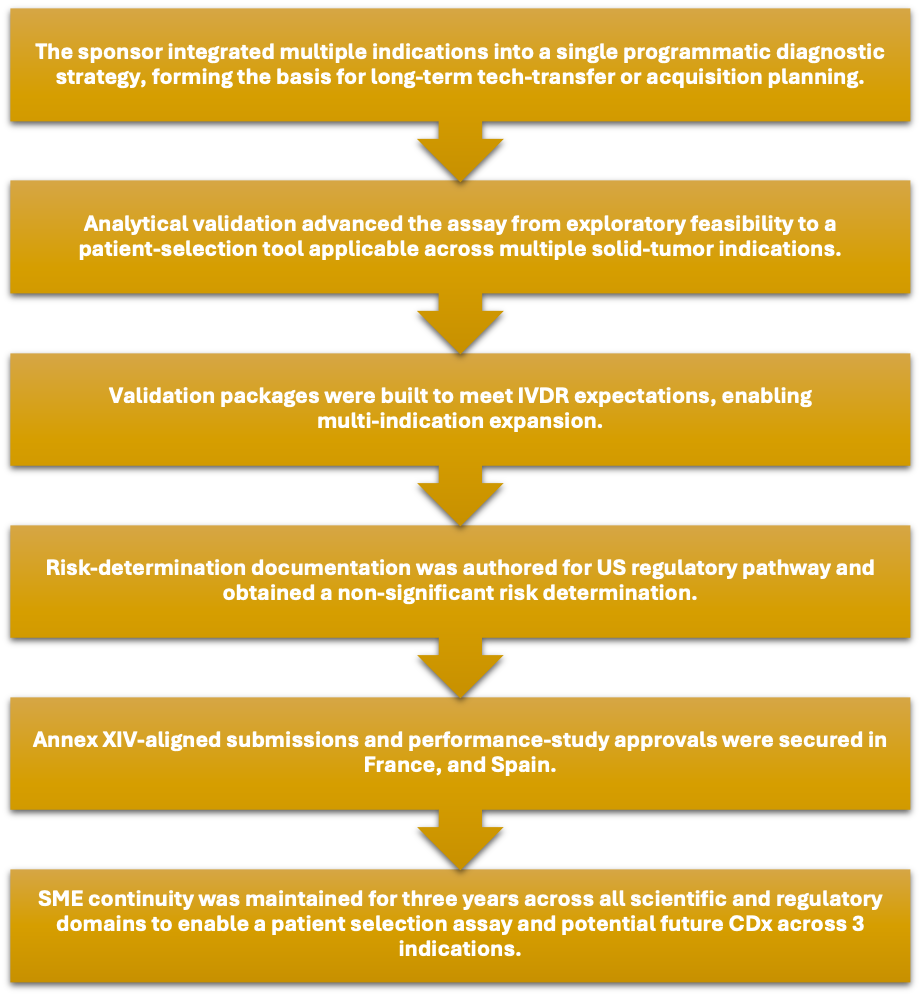
As confidence in the partnership strengthened, the scope of work expanded naturally. After establishing the assay and securing early approvals, the sponsor extended testing from ovarian to include NSCLC and endometrial cancers. Each new indication required additional validation, region-specific regulatory alignment, and updated performance study submissions. Because the assay had been developed using scalable analytical validation and a forward-looking regulatory strategy, these expansions were integrated without disrupting ongoing timelines.
Regulatory scaling followed the same trajectory. Device nonsignificant risk determination in the US supported early feasibility and positioned the sponsor for future IDE considerations without prematurely committing to a commercial CDx pathway. In Europe, Annex XIV submissions and performance study approvals were completed in France and Spain, strengthening the sponsor’s ability to run multi-country studies and establishing a durable template for future regions. This approach of build first and then replicating became a defining feature of the engagement and a key driver of its long-term efficiency.
Operational scaling also accelerated. Central lab contributions expanded to include kitting, logistics, multi-platform instrument use, biopsy testing, and cross functional project oversight. New capabilities, including advanced IHC and multiplex immunofluorescence capacity in Berlin and the pursuit of ISO 15189 accreditation in Winston-Salem, broadened the infrastructure available to the program. These expansions were strategic rather than reactive, establishing capabilities to support future diagnostics programs and enabling the sponsor to consider eventual technology transfer to a commercial distributor or potential integration following acquisition.
Throughout this partnership, continuity of SME support in regulatory, scientific, biospecimens, assay development, and study operations remained constant. This preserved interpretive stability and created the conditions for sustained expansion.
What the Work Made Possible
How a True Scientific Partnership Helped a Diagnostic Program Grow and Thrive
Early‑phase biomarker programs depend less on isolated technical strengths and more on the combined effect of scientific rigor, regulatory fluency, and execution continuity. This study demonstrates that the stability of early decisions (analytical, interpretive, and regulatory) must be engineered rather than assumed.
- Early phase diagnostic programs benefit from infrastructure scalability—such as expanded lab capabilities—that support downstream technology transfer or commercialization planning.
- SME continuity provides interpretive stability that cannot be replicated through layered communication or standard vendor models.
- A scalable analytical validation strategy enables multi-indication expansion without destabilizing ongoing clinical timelines.
- The Sponsor needed a partner with global regulatory experience (EU, UK, and US) with Companion Diagnostics capable of building the nonsignificant risk arguments, performance study submission packages and substantial modifications in alignment with IVDR and MHRA requirements. Multi-region performance study approvals require synchronized scientific and regulatory workstreams to avoid unnecessary iteration.
Taken together, these capabilities reflect a broader truth: early phase diagnostic global strategy succeeds when scientific, regulatory, and operational functions operate as a single construct. Continuity accelerates it.
Conclusion
The program evolved from a small exploratory research assay into a structured, multi-indication diagnostic development effort spanning the US, UK, and EU. Through sustained SME engagement, disciplined remediation of analytical challenges, and rigorous multi region regulatory execution, the partnership established a stable foundation for the sponsor’s early phase clinical strategy. The result is a maturing diagnostics program capable of supporting long term scientific, clinical, and commercial trajectories, grounded in a model that treats scientific continuity as the central determinant of early phase success.
This collaboration showed what becomes possible when a sponsor and scientific team grow alongside one another: adjusting, problem solving, and expanding the work in ways no one anticipated at the outset. The program evolved not because of a single decision or deliverable, but because the partnership itself stayed strong through each shift, each indication, and each regulatory milestone.
If your team is exploring early phase diagnostic development or needs a partner who can walk every step with you from the bench to multi region activation we would welcome a conversation about how we can help.