This is the story of how a monitoring only rescue team caught a silent PK problem before it damaged a Phase 1 CAR-T data package and persistent pattern recognition kept a complex trial on track.
What first looked like a few isolated sample issues quickly resolved into a pattern: time sensitive PK samples were arriving invalid at one of the four participating sites in a rare population, first in human (FIH), Phase 1 CAR-T trial. For a modality where every patient matters, every draw matters, and every hour counts, this was a potentially study shaping operational threat.
But because the monitors were watching closely, they connected the dots before it became a crisis. The sudden degradation in sample quality signaled something deeper: a likely staffing change at the site. That observation—made quietly, early, and based on hands on monitoring rather than vendor reports—set off the chain of events that ultimately protected the trial’s most sensitive data stream.
|
Therapeutic Area |
Oncology |
|
Indication |
Lung cancer (small cell / neuroendocrine) |
|
Study Phase |
Phase 1; First in Human; Dose Escalation ‑in‑Human; Dose Escalation |
|
Patient Segment |
Extensive / metastatic; pulmonary; second‑line |
|
Number of Patients / Sites |
26 pts in Part A, 17 in Part B / 4 (target accrual & reported sites) |
|
Study Design |
Rare disease; CAR‑T; biological cellular therapy; gene therapy; autologous; multiple indications; immuno‑oncology therapy |
|
Project Mandate |
Monitoring‑only rescue with transition and remediation activities |
|
Clinical Products |
Data Management; Financial PM; Technology Services; Contracts; Grants; Admin Fee; Clinical Ops; Pass‑Throughs; PM support |
The Challenge: A Monitoring‑Only Rescue in a High‑Risk Modality
Most rescue transitions begin with broad operational control—data cleaning, new governance, timeline resets, communication wiring, and even protocol amendments. This trial was different. The sponsor retained authority over logistics, site communications, and data vendor management. The rescue team was brought in only to monitor. And yet the situation they walked into required far more than routine monitoring.
An inherited backlog
At one site, only one or two monitoring visits had been completed before the rescue began, leaving a sizable backlog the new team had to resolve immediately.
A staggered, one‑patient‑at‑a‑time CAR‑T design
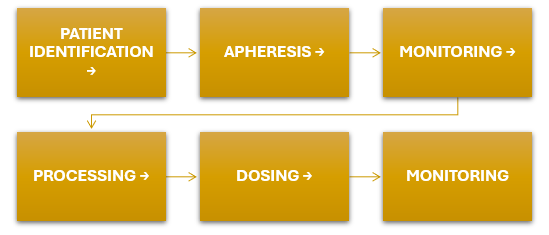
Each site could enroll only one patient at a time, and treatment proceeded through tightly timed apheresis → manufacturing → dosing sequences that made missed windows costly.
Vendor data that never aligned with visit timing
The external data management vendor delivered metrics every two weeks—unhelpful when monitors were onsite every four to six weeks, often before updated metrics were available.
Sponsor–site communication gaps
Sites communicated directly with the sponsor, excluding CRAs from visibility into newly identified patients, upcoming apheresis dates, dosing timing, and shifting treatment plans. As a result, compliance to visit frequency per clinical monitoring plan was a challenge and , monitors sometimes arrived at sites blind to recent communications.
A rare disease, FIH, cell‑therapy environment
With an autologous CAR‑T therapy aimed at a rare, aggressive cancer subtype, every data point mattered—particularly PK samples, which play a critical role in first‑in‑human safety, exposure, and response understanding.
CAR‑T‑specific operational complexity
This modality demanded CRAs who knew how to review cell‑therapy‑specific forms and manufacturing windows, and preempt site errors that could compromise dosing or patient safety.
The monitors were supposed to be “just monitoring.” But because of the design, the vendor cadence, and the sponsor‑led communication patterns, they had to reconstruct an entire operational rhythm from fragmented information—and do it while clearing a backlog and navigating staggered enrollment.
Inside the Cell Processing Workflow
The Transition: Deploying Experience and a SWAT Team
From the beginning, the rescue hinged on two strategic choices: deploying extremely experienced CRAs and bringing in SWAT resources to attack the backlog early.
Experienced CRAs capable of walking into CAR‑T complexity
CAR‑T monitoring isn’t like solid tumor oncology. As Marlise noted, many monitors with strong oncology backgrounds still aren’t prepared for CAR‑T because the modality is “so precise” and requires a different way of reading forms and assessing safety events.
The team assigned CRAs who already understood:
- the form‑level nuance of CAR‑T source data
- the implications of apheresis timing
- how deviations cascade into product availability
- PK sampling rhythms in early‑phase immunotherapy
SWAT involvement from the start
To clear the inherited backlog, SWAT CRAs were deployed immediately, ensuring experienced team members were not pulled away from forward‑looking monitoring cycles.
Establishing rhythm with busy, high‑volume sites
Although anonymized here, the transcript makes clear the sites were major cancer centers with heavy patient volumes and demanding schedules. Gaining time on their calendars required relationship capital—and fortunately, the team already had it. Existing relationships allowed the new CRAs to get rapid access for visits during the transition window.
Establishing presence in sponsor‑driven channels
One key early step was encouraging sites to CC monitors on emails they previously sent only to the sponsor—helping close the visibility gap the team inherited.
This transition phase didn’t change governance, scope, or overall study control. But it changed the monitoring reality completely: the team now had access, rhythm, and eyes on the ground.
Integrated Operations: Building a Real‑Time View Without Formal Control
Once the transition stabilized, the challenge was different: How do you maintain situational awareness in a CAR‑T rescue when you do not own communications, logistics, or data flow?
The team achieved it through several integrated operational moves.
1. Using EDC dashboards as real‑time truth
Because vendor metrics were always delayed relative to monitoring visits, monitors relied on EDC dashboards to track:
- pending queries
- overdue tasks
- real‑time CRF completeness
- PK sample entries
- treatment‑window alignment
Monitors could then walk into sites prepared, even if they had received no advance notice from the sponsor.
2. Tightening visibility on patient identification
Because sites often notified only the sponsor when a patient was identified, monitors risked missing crucial timing windows. To fix this, the team:
- encouraged sites to include them on patient‑status emails
- used meeting discussions to confirm upcoming apheresis or dosing dates
- cross‑checked EDC entries for early signs of patient movement
Eventually, an in‑house CRA also joined the team, helping manage between‑visit patient‑tracking tasks.
3. Aligning visit cadence with treatment windows
Originally, monitors were expected to visit one week post‑apheresis and two weeks post‑dosing—an aggressive cadence that was hard to meet because delays in patient readiness were common (e.g., brain metastases requiring treatment before enrollment).
The team worked with the sponsor to ease this requirement, enabling a more feasible four‑ to six‑week cadence and reducing the risk of misaligned visits.
4. Maintaining continuity through PM turnover
The trial experienced multiple PM transitions—each of which had the potential to disrupt communication. Despite these shifts, the monitors retained strong continuity because the clinical lead remained steady, and much of the relationship‑building rested with CRAs rather than PMs.
From Backlog to Stability
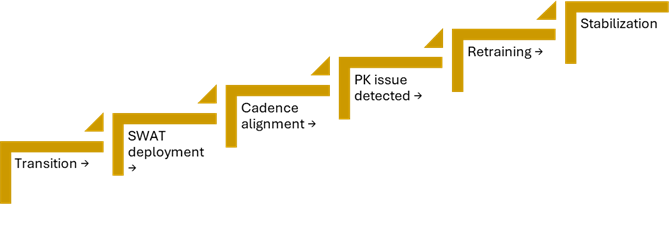
The Turning Point: Detecting a Silent PK Crisis
The most striking example of operational vigilance emerged in the area of PK samples—primary data critical to early‑phase CAR‑T studies.
A sudden change in sample quality
Monitors noticed that samples at one site were suddenly arriving invalid. These weren’t minor errors: samples were being held too long before shipment, missing the same‑day turn‑around expected for high‑sensitivity PK analysis.
Connecting it to a staffing change
Because the issue appeared suddenly after a long period of clean performance, monitors inferred a likely staff turnover at the site, which is something the site had not proactively reported.
Rapid site retraining
The team quickly escalated, and a retraining session occurred the same week the anomaly was recognized.
Preventing loss of critical FIH data
Given that PK was one of the primary objectives of the study, catching the problem early prevented potentially unrecoverable data loss. And because PK is what clinicians review closely in PI meetings, its absence would have impaired early risk–benefit evaluation.
This moment exemplifies the unique value the rescue team brought: they detected what automated reports could not. They saw a pattern, interpreted it correctly, and moved early enough to prevent consequences.

Result: A Stable, Predictable Monitoring Rhythm That Preserved Data Integrity and Won a Second Study
Although the rescue did not involve taking over study management, the team produced outsized impact, and they established a relationship with the Sponsor that goes beyond this single study.
Through early SWAT support and experienced CRAs, the inherited backlog was cleared quickly, allowing the trial to resume normal cadence. Early anomaly detection and rapid retraining prevented loss of critical PK samples at a moment when the study depended on them most.
Although the sponsor still managed direct site communications, monitors achieved increased CC’ing and better visibility into evolving patient status. A shift from an unrealistic post‑procedure visit schedule to a more manageable cadence reduced missed windows and prevented unnecessary deviations. Because CRAs anchored relationships and monitoring cadence, transitions in PM roles did not destabilize trial execution. With the addition of an in‑house CRA and stronger communication expectations, the team built effective between‑visit oversight.
The result: a monitoring‑only rescue that delivered precision judgment, pattern recognition, and operational glue.
Precision Protects What Matters Most
In a first‑in‑human cell therapy study, the difference between stability and setback often comes down to who is watching closely enough to notice the early signals. Here, the rescue team’s ability to detect subtle data shifts, interpret the operational story behind them, and intervene decisively prevented a quiet PK problem from becoming a major derailment. Their work didn’t just restore order; it safeguarded the integrity of a modality where every patient, every draw, and every hour matters.
More importantly, this isn’t a result that could be duplicated by a CRO without true fluency in trial operations nor would it detected by an AI agent. Neither could capture the lived nuance of what makes a rescue successful. And this rescue succeeded because of several human‑driven strengths that make Precision unique:
Precision Strengths
|
1. Pattern recognition
|
A machine would have seen invalid samples. A monitor saw a pattern and connected it to staffing turnover. |
|
2. Real‑time judgment
|
When vendor metrics lagged, the monitors didn’t wait. |
|
3. Relationship‑based execution
|
Sites responded quickly because CRAs had built trust long before the rescue began |
|
4. Modality fluency
|
CAR‑T monitoring is its own craft; the team deployed CRAs with the knowhow to interpret deviations, timing windows, and safety signals correctly. |
|
5. Courage to question the data
|
Seeing something unusual and calling it out—before it becomes a crisis—is one of the hardest skills in clinical operations. |
These Precision skills protected data, fixed the PK issue, and kept the trial moving. And these are the skills that differentiate a strong rescue from a cosmetic one.
If you’re evaluating support for an at‑risk study — whether you need targeted monitoring expertise, rapid transition support, or end‑to‑end rescue leadership — our team can help you stabilize quickly and protect the data that shape early‑phase decisions.
Let’s talk about how we can support your next drug development challenge.