



Autoimmune Drug Development with Immuno-Oncology Insight
As autoimmune therapies continue to shift toward mechanism-specific, biomarker-driven approaches, development becomes complex and more dependent on the ability to connect immune biology to clinical outcomes. Precision integrates clinical execution, specialty lab science, and translational expertise to help sponsors conduct trials built for this reality.
Connecting immune biology to trial execution
Built to integrate clinical development and biomarker science from the start, Precision for Medicine incorporates over two decades of biomarker-driven lab experience in oncology and rare disease into autoimmune clinical studies.
An Integrated Clinical + Lab Model, Grounded in Immune Science
When immune biology is central to development, success often depends on the ability to connect clinical execution with immune biology seamlessly. This model is particularly effective with early and mid-stage trials where translational evidence drives decisions and with advanced modalities.
Integrated
CRO+Specialty
Labs
Clinical execution and immune science are managed together, supporting continuity from protocol through data interpretation.
Proprietary Immune Monitoring
Epiontis ID® uses epigenetic quantification of immune cell populations, including Treg-specific measurement, to support deeper insight into immune response and therapeutic effect.
Translational Expertise for Trial Design
Biomarker strategies that inform patient selection, stratification, endpoints and safety.
Experience with Complex Modalities
Including cell and gene therapies where immune monitoring and mechanistic understanding are often critical to success.
Advanced biomarker capabilities designed to meet the needs of autoimmune studies
For autoimmune indications, a fit-for-purpose plan can combine immune-cell dynamics, cytokine/chemokine profiles, receptor occupancy with PK/PD relationships, and tissue signatures to build a credible differentiation story.
Explore
Tissue Biopsy Analysis
Support for all aspects of tissue biopsy analysis, including sample collection, a repository of 3M+ FFPE samples, global locations, and digital pathology solutions
Explore
Autoimmune Biospecimens
Inventory of a wide range of biospecimens including tissues, PBMCs and more
Explore
Clinical Logistics Services
Custom kitting, sample logistics, PBMC processing, and biostorage to meet the complex needs of autoimmune studies
Operationalizing biomarker-driven autoimmune trials
Precision for Medicine supports autoimmune trial execution with reproducible MoA and PD readouts that connect immune dynamics to clinical outcomes, enabled by integrated solutions.
Epiontis ID® assays are fully validated and can be rapidly set up to run
Epiontis ID® offers a dynamic biomarker strategy with over 35 validated immune cell assays, supporting clinical development across therapeutic areas. Our scientific team continuously expands the available cell types, often in response to client-specific needs. Beyond custom assay development, we integrate Epiontis ID® with complementary technologies to deliver a comprehensive biomarker solution. Study sponsors can select and combine any validated cell types into tailored panels for immune profiling and analysis.
Precision’s cell phenotyping technology, Epiontis ID, is ideal for use in autoimmune studies
Epiontis ID has been extensively used for immune monitoring in autoimmune studies across a range of indications, and has validated assays designed for specific autoimmune indications.
Below is data showing the number of studies Epiontis ID has been used for in various autoimmune indications.
| Indication | Number of studies | Number of samples | Study phase | Study years | Sample types |
|---|---|---|---|---|---|
Crohn's Disease |
4 |
9468 |
Phase 3 |
2018 |
Blood |
GvHD |
5 |
3411 |
Phase 3, research |
2016, 2017, 2018, 2019 |
Blood, tissue, PBMC, cells |
Psoriasis |
6 |
2834 |
Phase 1, 2, 4 |
2015, 2016, 2017, 2018 |
Blood, tissue |
Ulcerative Colitis |
2 |
1575 |
Phase 2 |
2015, 2016 |
Blood, tissue |
Asthma |
1 |
1350 |
Phase 2b |
2018 |
Blood |
Lupus |
2 |
1312 |
Phase 1, 2 |
2017, 2018 |
Blood |
Behcet's Syndrome |
1 |
672 |
Phase 4 |
2015 |
Blood |
Sjorgren's Syndrome |
5 |
479 |
Phase 1, 2a |
2015 |
Blood, DNA, PBMC |
Crohn's, Multiple Sclerosis/ Ulcerative Colitis |
2 |
390 |
Phase 1 |
2018 |
Blood |
Rheumatoid Arthritis |
2 |
375 |
Phase 1b, 2 |
2014 |
Blood |
Multiple Sclerosis |
2 |
330 |
Phase 1, 2 |
2016, 2017 |
Blood |
Celiac Disease |
1 |
204 |
Preclinical |
2016 |
Blood |
Atopic Dermatitis |
2 |
192 |
Phase 2a, 2b |
2018 |
Blood |
Myasthenia Gravis |
1 |
90 |
Phase 2 |
2018 |
DNA |
Peanut Allergy |
1 |
31 |
Preclinical |
2017 |
Blood |
IBD |
1 |
30 |
Preclinical |
2017 |
Tissue |
Diabetes |
2 |
20 |
Research, phase 2 |
2016, 2017 |
Blood, cells |
NASH |
1 |
48 |
Phase 1 |
2018 |
Blood |
Frequently Asked Questions
What challenges do biomarker-heavy autoimmune trials introduce, and how can they be addressed?
Biomarker-driven autoimmune trials introduce additional complexity beyond standard clinical execution.
Common challenges include:
-
Coordinating sample collection, handling, and processing across global sites
-
Ensuring assay selection and validation align with study goals
-
Managing variability in immune measurements across time and patients
-
Interpreting high-dimensional data in a clinically meaningful way
Addressing these challenges typically depends on having:
-
A well-defined sample and assay strategy tied to the protocol
-
Tight integration between clinical operations and laboratory workflows
-
Translational expertise to connect data outputs to clinical endpoints
Without this coordination, biomarker-rich trials can generate large amounts of data, but limited actionable insight.
When does it make sense to use an integrated CRO and specialty lab model in autoimmune development?
An integrated CRO + specialty lab model is most valuable when biomarker data directly influences how a trial is conducted or interpreted. This is often the case in:
-
Early- and mid-stage trials where mechanism and pharmacodynamics are still being defined
-
Programs requiring patient stratification or enrichment strategies
-
Studies with complex immune monitoring requirements
-
Indications where clinical endpoints alone are insufficient for differentiation
In these settings, separating clinical execution from laboratory and translational work can create gaps in communication, timing, and data interpretation. An integrated model can help ensure that:
-
Biomarker decisions are reflected in protocol design
-
Sample logistics and assay execution align with study timelines
-
Data is interpreted within the context of the trial—not in isolation
What should sponsors look for in a CRO supporting CAR‑T therapies in autoimmune diseases?
CAR‑T and related cell therapies are emerging as promising approaches in autoimmune disease, but they introduce new levels of complexity in clinical development. Sponsors evaluating CRO partners for these programs should consider:
-
Experience with both cell and gene therapy trial execution and autoimmune indications
-
Capability to look for and identify persistence, response, and safety signals
-
Integration between clinical operations and specialty lab services
-
Ability to manage complex workflows, including biospecimens, sample logistics, and assay strategy
Because CAR‑T therapies rely heavily on understanding immune response over time, successful programs often depend on partners who can connect clinical execution with deep immunological insight. Precision for Medicine has supported more than 30 CAR‑T–related projects, helping sponsors design and execute programs where immune monitoring and translational understanding are critical to trial success.
Discuss your autoimmune program with our experts who can suggest ideal solutions for your program’s needs
Curated Insights
Experiences, tips, and perspectives from experts on the front lines of research.
All Resources-
Case Study
Developing and Validating Clinical Receptor Occupancy Pharmacodynamic Biomarker Assays
Download Case Study
-
Case Study
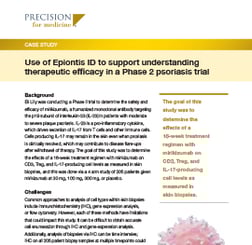
Use of Epiontis ID® to support understanding therapeutic efficacy in a phase 2 psoriasis trial
Download Case Study